Born: Xiangfan City, Hubei province, 1971.
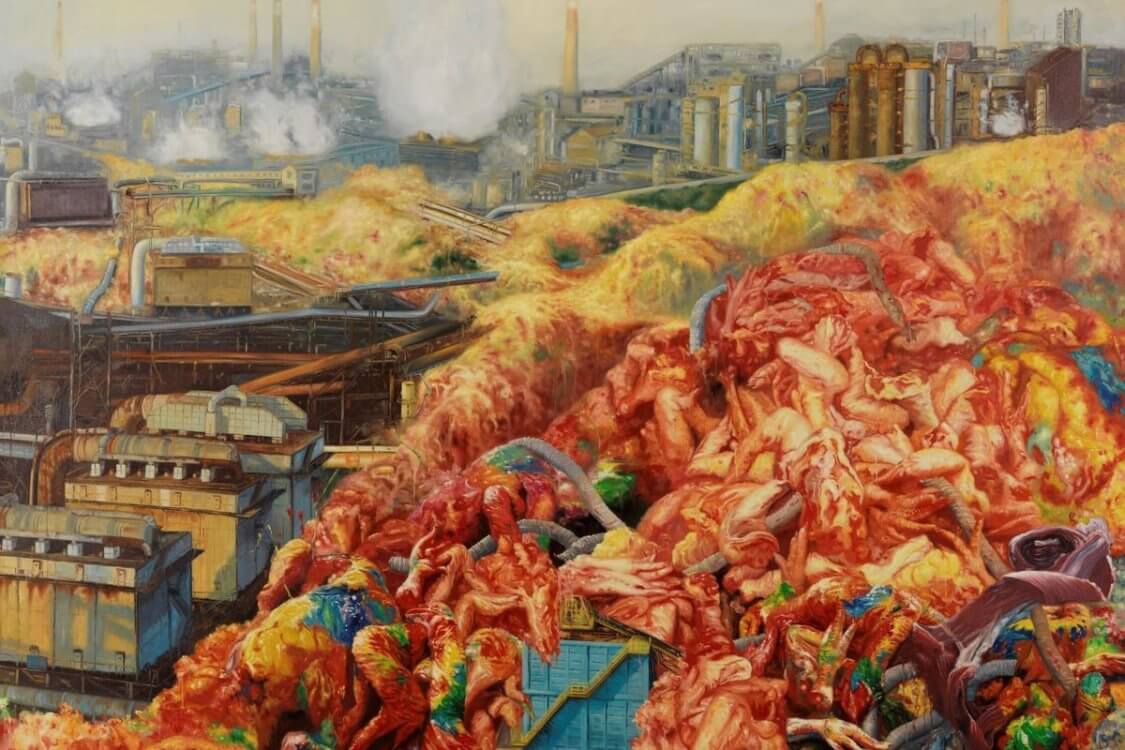
It was not uncommon for classical Chinese artists to paint the same subject over and over. They might focus on landscapes, courtiers, animals or flowers. Liu Haizhou paints chickens—dead ones. He has painted them reclining like classical nudes, slumped like hungover party-goers, and piled up like garbage. To him, factory-farmed chicken meat is emblematic of the changes taking place in China: mass production, which turns living things into commodities; the mass consumption it has made possible; and mass contagions like SARS and avian flu. Churning out disemboweled and dismembered chickens by the conveyor-belt load “is going against nature”, says the artist—who, in one of the White Rabbit Collection’s most unlikely pairings, is married to Du Jie. His Gorgeousness Overripe No. 17 (2005) shows chickens, bright green with putrefaction, pink with toxic mould and scrawled with graffiti: “We love eating chicken,” “Chicken is the best gift”. Gorgeousness Overripe No. 21 (2007) presents slag heaps of chicken between factory sheds and smoking chimneys. Scrutinising his carcasses like a forensic pathologist, Liu Haizhou surely knows more about dead chickens than any artist on earth, and perhaps more than even he wants to know. But the effort is worthwhile, he believes, if it will help people think harder about “this industrialised, artificial world” and weigh its benefits against those of “the natural way”.