“When the light of the sacred disappears, people transfer their religious impulses to material things.”
Born Kaohsiung City, Taiwan, 1969
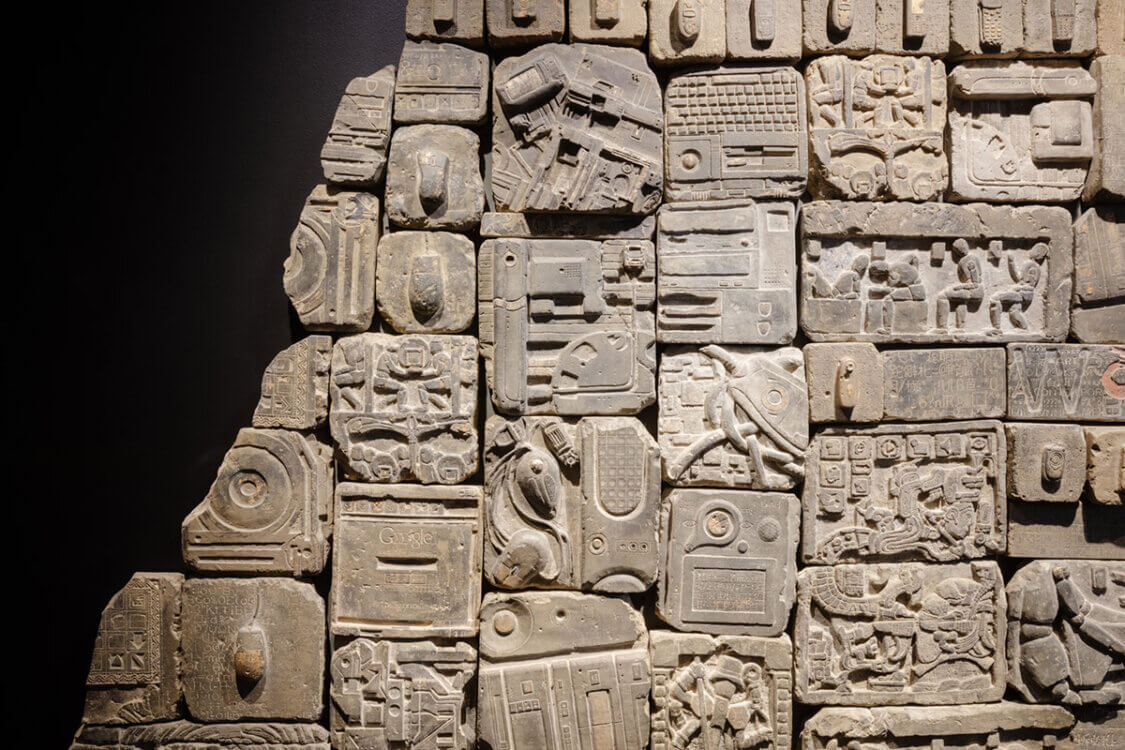
Tu Wei-Cheng’s works are wildly varied, but if he has a recurring trope it is the optical illusion. Happy Valentine’s Day (2011) is a chocolate shop, all decked out with hearts and pink ribbon, where the chocolates are tiny tanks, guns and hand grenades. The installation is a reflection on the narrow divide between love and war, particularly in the context of Taiwan’s fraught relationship with China. “Who is the lover who sends these weapon-shaped chocolates?” the artist asks. “Is it a threat that states, ‘Lover beware’? … Does it symbolise friendly military aid? Or does it reveal interest in a military purchase? … If love is not carefully managed, it has the potential to transform the world of both parties.” In an earlier large-scale “hoax”, Tu Wei-Cheng manufactured an entire archaeological dig and a museum to show its finds. The centrepiece of that multi-site installation, Bu Num Civilisation Revealed (2011), is a fake-stone wall covered with bas-reliefs that seem to depict acts of worship and sacred objects. On closer inspection, the carvings show people hunched at computer screens, surrounded by keyboards, iPhone app icons, GameBoy consoles and hard drives. “The Internet opens a door into what resembles a spiritual plane,” he says. “We spend the day facing the sacrificial altar of the computer.”